
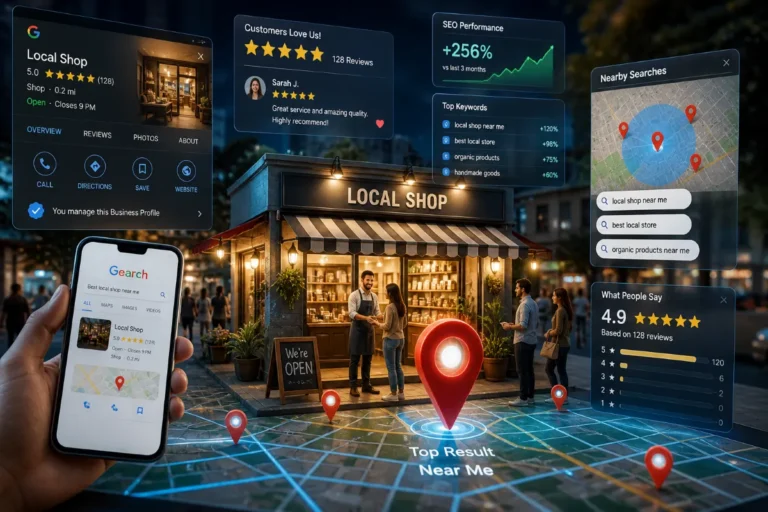
Your Customers Are Searching Nearby — But They’re Finding Someone Else
A person in Dehradun searches “best dentist near me.”
Another searches “digital marketing company in dehradun.”
Someone else types “AC repair near me urgent.”
These are not casual searches made out of curiosity.
These are high-intent moments where the customer already knows the problem and is actively looking for the nearest trustworthy solution.
And this is where many businesses lose opportunities without even realizing it.
Google is sending those customers to whichever business looks the most relevant, active, and reliable in that moment — not necessarily the business that actually offers the best service.
That means a better salon can lose to a mediocre one.
A skilled coaching institute can lose inquiries to a competitor with stronger reviews.
A reliable local agency can lose leads simply because it doesn’t show where people are looking.
This happens before the customer ever reaches your website.
Before they compare prices.
Before they ask for details.
Before they even know your business exists.
What most businesses don’t realize is this:
local search invisibility is not just a branding issue — it is a direct lead leakage problem.
You are losing customers at the discovery stage itself.
That is the real business cost of poor local visibility.

In simple terms, Local SEO is the work done to help your business appear when people in your city or nearby area search for the services you offer.
Not just on normal Google search.
But specifically in places that influence local buying decisions fastest:
So if someone searches:
Local SEO decides whether Google understands that your business is a strong answer to that search.
And that word understands matters.
Because Google does not rank local businesses simply because they exist.
It ranks businesses when enough local trust signals tell the algorithm:
this business is relevant here, active here, and trusted by people here.
This is less about “having a website” and more about building digital proof of local relevance.
Also Read: Why Most Businesses in Dehradun Are Not Getting Leads Online (Even After Investing in SEO)
Many business owners assume:
“We have a website and some SEO done, so people should find us.”
Not necessarily.
Traditional SEO mostly focuses on ranking webpages broadly:
That helps visibility at a wider level.
But local buying behavior does not work like informational browsing.
A person looking for “home tutor in dehradun” is not trying to read five articles.
They want:
This is where ranking alone is no longer enough.
Because more traffic does not always mean more leads.
You can have blog visitors and still miss buyers.
Google knows local searchers usually want immediate action, so it prioritizes:
Meaning broad SEO may bring visitors.
But Local SEO brings people much closer to conversion.
That difference changes the quality of inquiries you get.

This is where many owners get frustrated.
They know they do good work.
Customers are happy.
Referrals happen.
But online? Barely visible.
Usually the issue is not quality of service.
It is weak local signals.
And weak local signals create a trust gap between what your business actually is and what Google thinks your business is.
Common reasons:
Incomplete Google Business Profile
No regular updates, weak descriptions, missing services, poor categories.
Weak Review Trust
A competitor with 80 genuine reviews looks safer than a business with 7 old reviews.
Poor City Relevance
Your website talks about services, but not clearly enough about where you offer them.
No Location Authority Pages
No pages targeting actual city/service combinations people search.
Inconsistent Business Information
Different phone numbers, old addresses, mixed listings online — Google reads this as uncertainty.
What most businesses don’t realize is that Google hates uncertainty.
If your signals are inconsistent, Google would rather rank a slightly weaker but clearer competitor.
So yes, you may be the better business.
But Google cannot rank what it cannot confidently verify.
Google does not pick businesses randomly.
It compares trust signals and predicts which business is most likely to satisfy that local search.
Here’s what heavily influences local placement:
How close is the business to the searcher or searched area?
Is the Google Business Profile fully built out with services, categories, hours, images, updates?
Not just review count — freshness, consistency, and actual wording matter.
Does the connected website support local service relevance?
Does the same business name, phone, address, and details appear consistently online?
Do people click, call, ask directions, spend time, view photos?
Here is the mechanism most people miss:
Google watches how users interact with local listings.
If users repeatedly choose, click, call, review, and engage with a business, Google gets behavioral confirmation that this listing is satisfying intent.
So local rankings are not only built by setup.
They are reinforced by trust + activity + user response.
That distinction is huge.

India’s local buying behavior has changed fast.
Most local discovery now happens on mobile.
People do not sit and “research brands” the way they used to.
They search in moments like:
Then they immediately:
Which means the decision window has become shorter.
Businesses are being judged in seconds, not in long consideration cycles.
Take a coaching center in Dehradun.
A parent searching “best NDA coaching in dehradun” will usually shortlist from the first few visible local options before opening ten websites.
Same with clinics, cafes, real estate consultants, home service providers, and agencies.
Google Business visibility has become the first layer of trust.
If you are not visible there, you are often invisible in the buying decision itself.
This is where many businesses go wrong.
They claim a Google listing.
Upload a logo.
Add phone number.
Then assume Local SEO is done.
It is not.
That is like putting a signboard outside a shop and assuming footfall will keep increasing on its own.
A listing is only the shell.
Performance comes from what keeps feeding that shell with relevance.
Real Local SEO includes:
Google wants repeated confirmation that this business is:
A dead listing with no movement tells Google the opposite.
Google Business Profile Optimization
Your profile needs more than basics.
It needs:
A neglected profile tells Google and users the same thing: low activity.
Ten reviews collected in 2022 are not enough.
Google prefers businesses that continue earning reviews because ongoing reviews indicate ongoing customer trust.
And review wording matters.
A review saying “best skin clinic in Dehradun for acne treatment” gives Google both service relevance and local relevance.
So the strategy is not “ask for reviews sometimes.”
The strategy is building a repeatable review acquisition habit.
Most business websites are too broad.
A salon page saying “we provide beauty services” is weak.
A page answering:
is much stronger because it mirrors actual search intent.
Google ranks specificity better than vagueness.

Your Name, Address, Phone must stay consistent across:
This is not clerical work.
This is trust alignment.
The more the web confirms the same business identity, the easier it becomes for Google to trust that entity.
If you serve multiple areas, create real service-location pages.
Not copied city spam pages.
A plumber serving Sahastradhara Road, Rajpur Road, and Clement Town should not have one generic service page trying to rank everywhere.
Area-level relevance improves local matching.
People search conversationally now:
Pages that answer natural buyer questions perform better in both search and AI-generated answer systems.
Businesses with:
look alive.
And users interact more with businesses that look alive.
That interaction itself becomes another trust signal.
Let’s make this practical.
Example 1: Clinic in Dehradun
Someone searches skin specialist near me.
They see:
The user feels lower risk contacting that clinic.
That perceived trust is what earns the call.
Example 2: Coaching Institute
A student searches best SSC coaching dehradun.
Visible listing + location pages + FAQs + review proof = inquiry form or direct call.
The institute is not winning because of “SEO traffic.”
It is winning because it removed hesitation.
Example 3: Home Service Provider
Urgent electrician search.
Nobody reads long articles.
The business that appears trusted and nearby wins because urgency compresses decision-making.
This is how local SEO works in real life:
search → compare → trust → contact → conversion
Very little friction.
Many businesses are unintentionally holding themselves back.
Common mistakes:
Individually these look minor.
Collectively they tell Google:
this business is not strongly maintained.
And poorly maintained businesses rarely dominate local results.
Yes — and this matters more than many businesses think.
Ads rent attention.
Local SEO builds discoverability.
That is a major difference.
Google Ads can absolutely generate quick visibility.
But the moment ad spend stops, so does traffic.
Local SEO works differently.
Each improvement you make adds to a long-term local asset:
This compounds over time.
So while ads buy temporary placement, Local SEO builds repeated eligibility to appear.
That makes it far more sustainable for many small businesses.
Do not try to do everything blindly.
Prioritize in this order:
This order matters.
Because many businesses waste months doing scattered SEO tasks without fixing the signals Google checks first.
This is not a one-time checkbox.
Google keeps evaluating:
Competitors keep moving too.
What most businesses underestimate is consistency.
One optimization session may improve presence.
Consistent signal improvement is what creates local dominance.
And this is where it becomes difficult internally.
Business owners are already managing staff, customers, operations, and sales.
Tracking reviews, listings, local pages, updates, citations, FAQs, and performance month after month requires a system — not occasional attention.
This is exactly where many local businesses get stuck.
They know they need visibility.
They may even know some of the tasks involved.
But they do not have the time to connect all the moving pieces into one ranking system.
At UpCrawlMedia, the focus is not simply on “doing SEO activities.”
The focus is building a local lead engine through:
In practical terms, this means helping Google trust your business faster and helping local customers choose your business with less hesitation.
That is where rankings begin turning into inquiries. Let Us Take Care Of your SEO
A lot of small businesses assume quality alone should bring customers.
Offline, maybe.
Online, discoverability decides opportunity.
If people nearby are searching daily for exactly what you offer, but your competitors keep appearing first, then the issue is no longer just marketing.
It is a visibility gap that keeps turning into missed revenue.
Local SEO solves that gap.
It helps your business become visible at the exact moment someone is ready to act.
And in local business, timing often matters more than persuasion.
Because the business that gets seen first usually gets considered first.
If your business has been struggling to show up where local customers are actually searching, getting experienced eyes on the problem can save months of random trial and error.
Sometimes the issue is not your service.
It is simply that Google has not yet been given enough structured reasons to choose you.
And that gap is usually fixable once the right local signals are identified and strengthened.
At UpCrawlMedia, we help small businesses uncover where those missed local opportunities are coming from and build a clearer path to stronger Google visibility, better inquiries, and more consistent lead flow.
If your business is not showing where local customers are searching, this may be the right time to look at what Google is actually seeing — and what it is not.
No — and this is one of the biggest misconceptions.
A Google Business Profile is the starting point, not the full strategy.
Google still cross-checks:
A half-optimized profile without supporting local signals usually struggles to stay competitive.
Both matter, but they influence different parts of trust.
Reviews help Google and users see that the business is active and credible.
Website SEO helps Google understand what services you offer and which locations you are relevant for.
A business with reviews but weak website support often plateaus.
A business with website pages but weak reviews often gets ignored by users.
Local SEO works best when both reinforce each other.
Not necessarily.
Google Ads can bring immediate paid visibility, but Local SEO builds unpaid recurring discoverability.
Many small businesses use ads for short-term demand and Local SEO for long-term lead stability.
If budgets are limited, building local organic presence often gives better compounding value over time.
Simply being listed does not guarantee visibility.
Common reasons include:
Google chooses businesses it trusts most for that local search, not just businesses that exist.
This is why many listed businesses remain buried.
Definitely ongoing.
Google keeps measuring freshness:
Competitors are also improving.
Businesses that treat Local SEO like a one-time checklist often lose momentum after initial setup.
