
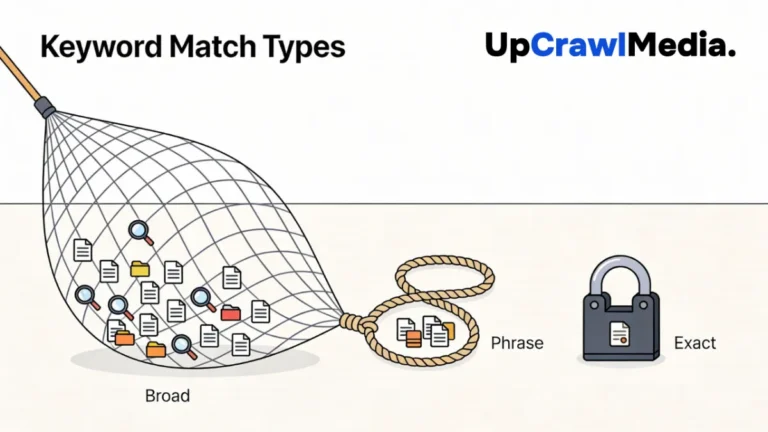
Google Ads is built around keywords. When someone searches on Google, your ads appear based on how closely their search matches the keywords in your account. Keyword match types control this matching process.
Understanding match types is essential for running effective Google Ads campaigns. They influence who sees your ads, how much you pay, and how relevant your traffic is. This guide explains keyword match types from the ground up, with simple examples and practical context.

Keyword match types tell Google how strictly a search query must match your keyword for your ad to appear.
You don’t just choose what keyword to target. You also choose how flexible Google can be when matching it to user searches.
For example, if your keyword is running shoes, should your ad show for “best shoes for jogging” or only for “running shoes”? Match types answer that question.
Google Ads currently supports three main keyword match types:
Each one balances reach and control differently.
Match types directly affect performance. They decide how many people see your ads and how relevant those people are.
A loose match can bring more traffic but may include irrelevant searches. A strict match reduces wasted clicks but limits reach.
Budget is also impacted. Showing ads for broader searches can increase spend quickly. More precise matching often results in lower wasted spend but fewer impressions.
Choosing the wrong match type can lead to low-quality traffic, poor conversion rates, or overspending. Choosing the right one helps align ads with actual user intent.
Broad match is the default setting in Google Ads.
Your ad can show for searches that are related to your keyword, even if the exact words are not used. Google uses signals like user intent, synonyms, and past search behavior.
Example:
Keyword: running shoes
Possible searches:
Broad match offers the widest reach. It helps discover new search terms but offers the least control.
Phrase match offers a balance between reach and precision.
Your ad can appear when the search includes the meaning of your keyword, even if extra words are added before or after.
Example:
Keyword: “running shoes”
Possible searches:
The search must still reflect the original intent. Phrase match filters out many irrelevant searches while still allowing some flexibility.
Exact match is the most restrictive option.
Your ad shows only when the search closely matches your keyword’s meaning. Minor variations like plurals or word order are allowed.
Example:
Keyword: [running shoes]
Possible searches:
Exact match gives the most control. It limits exposure to highly relevant searches but reduces overall reach.
| Match Type | How Google Matches Searches | Level of Control | Reach | Typical Use Case |
| Broad Match | Shows ads for related searches, synonyms, and variations based on user intent | Low | High | Discovering new search terms and reaching a wide audience |
| Phrase Match | Shows ads when the search includes the keyword’s meaning with extra words before or after | Medium | Medium | Balancing reach and relevance once you understand user intent |
| Exact Match | Shows ads only for searches very close to the keyword’s meaning | High | Low | Targeting high-intent searches that are proven to convert |
Broad match focuses on reach. Phrase match focuses on relevance with flexibility. Exact match focuses on precision.
Broad match captures the widest audience but can include loosely related searches. Phrase match narrows that audience while still expanding beyond exact wording. Exact match targets users with very specific intent.
As control increases, reach decreases. As reach increases, relevance may drop. Most successful campaigns use a mix rather than relying on just one match type.
Broad match is useful when you want to explore search behavior or reach new audiences. It works well in early campaign stages or when combined with strong negative keywords.
Phrase match is suitable when you understand your audience and want consistent relevance without being overly restrictive.
Exact match is best when performance data is available. It works well for high-intent keywords that consistently convert.
Many advertisers start broad, analyze performance, and then shift successful terms into phrase or exact match.
One common mistake is using only broad match without monitoring search terms. This often leads to irrelevant clicks.
Another mistake is relying only on exact match early on. This can limit data collection and slow campaign learning.
Ignoring negative keywords is also a major issue. Without them, even phrase and broad match can trigger unwanted searches.
Some businesses also assume match types work exactly as they did years ago. Google’s matching logic has evolved, and understanding current behavior is important.
Broad match usually generates more impressions and clicks. Costs can rise quickly if searches are not relevant.
Phrase match typically delivers moderate volume with better alignment to intent. Costs are often more predictable.
Exact match usually brings fewer clicks but higher intent traffic. Conversion rates tend to be higher, and wasted spend is lower.
The goal is not the cheapest click. The goal is traffic that aligns with what your business actually offers.
Start with clear goals. Decide whether you need visibility, data, or efficiency.
Use a combination of match types. Broad match helps discover opportunities. Phrase and exact match help refine performance.
Review the search terms report regularly. This shows the actual queries triggering your ads.
Add negative keywords consistently. This improves relevance across all match types.
Adjust bids based on performance rather than assumptions. Let data guide match type decisions.
Professionals rarely rely on one match type.
They often use broad match with smart bidding and strong negative keyword lists. High-performing search terms are then moved into phrase or exact match campaigns.
They separate match types into different ad groups or campaigns. This allows better control over bids and budgets.
Performance is monitored continuously. Match types are adjusted based on real user behavior, not guesswork.
Keyword match types follow clear rules. Once those rules are understood, deciding how to structure keywords becomes much simpler.
When building campaigns, advertisers often need to convert a single keyword into broad, phrase, and exact match formats. Doing this manually can be repetitive, low down campaign setup and increase the risk of formatting errors, especially when working with long keyword lists.
A keyword match type tool simplifies this process. You enter a keyword once, and the tool instantly generates:
This helps ensure that keywords are structured correctly without memorizing syntax or making formatting mistakes.
If you want to apply what you’ve learned without manual effort, you can try our free keyword match type tool to instantly generate broad, phrase, and exact match versions of any keyword.
Using a tool like this helps keep keyword structure clean, consistent, and aligned with match type rules—especially when managing multiple campaigns or learning Google Ads fundamentals.
