
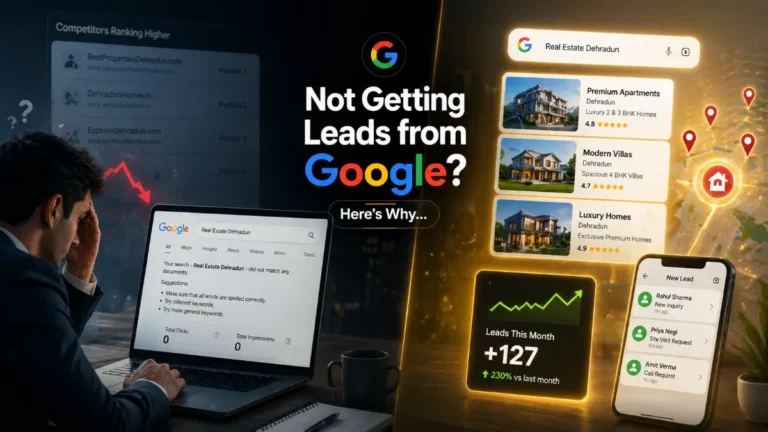
Many real estate companies in Dehradun have solid inventory, active sales executives, and enough budget to promote projects.
Yet when it comes to direct property inquiries from Google, the results are often disappointing.
Calls are inconsistent. Website forms stay empty. WhatsApp inquiries are low.
So businesses continue relying on:
The problem is these channels often bring low-intent or shared leads. A buyer inquiry on a portal may be sent to multiple agents at once, which reduces conversion quality.
This creates paid listing fatigue. Money is spent, but lead ownership stays weak.
What most businesses do not realize is that they are renting attention, not building their own inquiry source.
As long as the lead comes through someone else’s platform, the business stays dependent on that platform’s pricing, visibility rules, and competition.
In many cases, the issue is not the project itself.
The issue is the online lead system behind the project.
A few years ago, many builders and dealers could survive on:
Those methods still exist, but buyer behavior has changed.
Today, most property buyers do online validation before speaking to anyone.
They search terms like:
Then they compare websites, maps listings, reviews, and project details.
Even if a broker recommends a builder, the buyer still checks Google first.
This means online visibility is no longer just a traffic source.
It has become a trust filter.
A business may still get referred offline, but the final trust decision is increasingly happening online.
That shift is important because many real estate companies are still marketing as if discovery and trust are the same thing. They are not.
Someone finding your name is discovery.
Someone believing your project is worth an inquiry is trust.
Google itself has also shifted heavily toward answer-first search experiences through AI summaries, changing how users interact with business information before clicking websites.
Many companies assume that having listings on portals like 99acres or MagicBricks means they are digitally visible.
But portal visibility is borrowed visibility.
A buyer searching directly on Google may never find the builder’s own brand.
That means the business is discoverable inside someone else’s ecosystem, not its own.
This also means every month starts from zero again — renew listing, pay again, compete again.
Owned Google visibility works differently. A ranked page, trusted map profile, or indexed project page keeps compounding instead of resetting.
A homepage saying “Welcome to XYZ Builders” is not enough.
Buyers search specific intent phrases such as:
If those dedicated pages do not exist, Google has nothing highly relevant to rank.
The website becomes a brochure, not a lead engine.
What most businesses miss here is search specificity.
Google does not rank websites simply because they exist. It ranks pages that closely match a buyer’s exact search language.
So one generic services page cannot compete against location-driven property intent.
A weak Google listing often includes:
This matters more than many businesses think.
Before visiting a website, buyers often scan the map profile to judge whether the builder looks active, legitimate, and locally established.
An inactive profile quietly sends a negative signal.
Even without saying anything directly, it suggests neglect.
That hurts trust before the website visit even begins.
Some businesses do invest in Google Ads.
But the ad click goes to:
The visitor lands, scans, gets uncertain, and exits.
The ad did its job.
The page did not.
This is where many companies misread performance.
They assume ads are expensive or ineffective.
In reality, the targeting may be fine — the post-click experience is what breaks buyer confidence.
More traffic does not always mean more leads if the landing page gives the buyer no clear reason to continue.
Even when traffic comes, many websites lack:
So users visit but do not act.
This is where many Dehradun businesses quietly lose leads every day.
A buyer interested in a 70 lakh to 1 crore property will not fill a form casually.
They need reassurance.
That reassurance usually comes from:
Without those, curiosity never becomes inquiry.
This is one of the biggest misunderstandings in property marketing.
A business can have:
and still not generate meaningful inquiries.
Because traffic is only the first layer.
Real estate requires:
The actual Google lead chain looks like this:
Search Visibility → Click Trust → Page Confidence → Quick Action Option → Sales Follow-Up
If even one stage breaks, the lead drops.
This is why ranking alone is no longer enough.
A #1 keyword position with a weak page can underperform a #3 result with stronger trust and faster contact options.
So rankings alone do not equal real estate leads Dehradun businesses can close.
Look, you could build the most beautiful website in the world… but if nobody finds it? It’s like setting up a burger shop in the middle of a desert.
Here’s what smart SEO can bring you:
So yeah, learning what is SEO and how to make it work for you? Kinda a game-changer.
Smarter builders create pages based on:
For example:
“Luxury flats on Rajpur Road” or “Investment plots near Premnagar.”
This gives Google a clearer page-topic match.
But more importantly, it gives the buyer the feeling that the page was made for their exact need, not for everyone.
That improves both rankings and inquiry confidence.
Instead of broad words like “property,” they target phrases closer to purchase:
This reduces wasted spend.
A practical difference here is intent temperature.
Someone searching “property in Dehradun” may just be browsing.
Someone searching “ready to move flats near ISBT Dehradun” is much closer to action.
Good campaigns filter for buying readiness, not just search volume.
Buyers do not only search listings.
They also search doubts.
Examples:
These educational pages build early trust.
What most builders ignore is that buyers often consume advice content first and listing content later.
So the company that answers the question early often becomes the company remembered later.
Every serious project should have:
It should also answer hesitation points like:
Because the more uncertainty removed on-page, the less resistance before contact.
The buyer journey is no longer simple.
Usually it looks like this:
This means the buyer is not deciding only from one ad.
They are building confidence across several digital touchpoints.
This is where many businesses misjudge lead generation.
They think one ranking page or one ad should produce the inquiry.
But buyers are making cumulative trust decisions.
Each touchpoint either adds confidence or adds doubt.
If your digital assets do not support this journey, visibility alone will not convert.
A builder selling luxury flats on Rajpur Road needs:
Because that buyer is comparing lifestyle and brand confidence, not just square footage.
A plot dealer in Premnagar needs:
Because that buyer usually wants quick location clarity and rate discussion.
An apartment project near Sahastradhara Road needs:
Because many buyers there are evaluating future appreciation and liveability together.
Each segment requires a slightly different property marketing Dehradun approach.
That is why copy-paste digital marketing rarely performs well.
Some repeated patterns appear across many businesses:
These are not small technical misses.
Together, they break the full lead system.
More importantly, they create leakage at every stage — discovery leakage, trust leakage, and inquiry leakage.
So even when marketing budget exists, the lead flow still feels weak.
SEO alone is no longer enough.
Search has shifted from “who ranks” to “who Google trusts enough to reference.”
That includes:
AI Overviews now pull summarized answers from sources that appear structured, credible, and contextually useful.
This means businesses need to stop thinking only in terms of ranking pages and start thinking in terms of becoming a recognized local information source.
That is where Generative Engine Optimization matters.
The companies likely to win are not always the ones shouting the loudest.
They are often the ones sending the clearest trust signals.
Yes — but only when four systems work together:
Missing one usually weakens the other three.
So the first priority is not “do everything.”
The first priority is finding which of these four systems is currently broken.
That is why some businesses get clicks but no calls, while others generate steady inquiries.
Don’t just sit there waiting for Google to find you—introduce yourself.
This helps Google discover, crawl, and rank your pages faster. It’s like waving at the bots and saying, “Hey, Over here”
SEO can feel overwhelming at first, but you don’t need to do everything at once. Focus on small wins: Pick the right keywords, Write great content, Make sure your site runs smoothly, Get a few solid backlinks. Do that consistently? You’re way ahead of most.
And remember, SEO is a long game. It’s not about instant results—it’s about building steady, long-term growth that doesn’t vanish when your ad budget runs out.
By this stage, one thing becomes clear: generating consistent property leads from Google is rarely about doing one marketing activity in isolation.
It usually comes down to fixing multiple weak points that are interrupting the buyer journey.
Some businesses are not ranking for high-intent property searches in Dehradun.
Some appear in search but fail to build enough trust to earn inquiries.
Some invest in Google Ads campaigns but send buyers to pages that do not convert.
Others have decent traffic but no proper local SEO or follow-up structure to turn that visibility into calls.
This is why disconnected tactics often produce disconnected results.
For example, SEO for real estate Dehradun works best when location pages, buyer-intent content, and trust signals are built together — not as random blog additions.
In the same way, Google Ads management for Dehradun property businesses performs better when ad targeting is tied to dedicated landing pages instead of sending paid traffic to a generic website.
Even Google Business Profile optimization plays a larger role than many expect, because local reviews, office credibility, and map visibility often influence whether a buyer chooses to call now or keep comparing.
What most builders and property dealers need is not scattered digital activity.
They need a connected local lead generation system.
That usually involves:
This is the approach UpCrawlMedia uses while helping real estate businesses improve online property lead generation.
Instead of treating SEO, ads, maps, and landing pages as separate services, the focus stays on one practical question:
where exactly are qualified buyers dropping off, and which part of the lead system needs to be rebuilt first?
That usually creates a more stable path toward qualified real estate inquiries instead of temporary traffic spikes.
Costs vary based on competition, goals, and scope. SEO should be viewed as an investment, not an expense.
They serve different purposes. Ads bring quick visibility; SEO builds long-term stability.
Referrals are great — SEO complements them by capturing people actively searching online.
Basic SEO is possible, but scaling results usually requires experience, tools, and time.
