
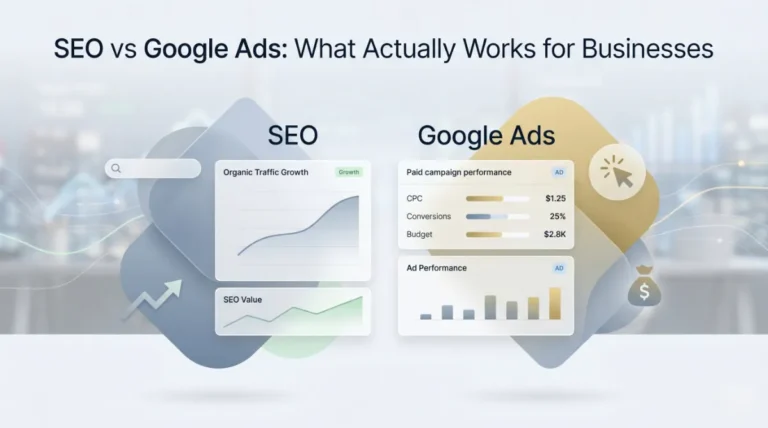
Most business owners are not trying to learn marketing theory.
They are trying to answer simple, practical questions:
These questions usually come after trying something that didn’t work.
The important thing to understand is this:
There is no single correct answer for every business.
What works depends on your stage, your budget, and how your website is set up. This is not a generic comparison—it’s a decision based on context.
The way people search online has changed.
Search engines now show more direct answers. Features like AI summaries often give users information without requiring them to click on a website. You can explore how search works in detail through resources like Google Search Central.
At the same time:
This leads to an important shift:
Visibility is easier than before, but getting actual leads is harder.
Just appearing on search results is no longer enough. What matters is what happens after someone clicks.
If you need a simple starting point:
However, this only works if your website and messaging are clear.
Even the best traffic will not convert if the user does not understand what you offer or what to do next.

What SEO Really Means Today
SEO is not just about ranking on search engines.
It is about:
In simple terms, SEO helps people find you naturally over time.
You Can Also Read: How Long SEO Take to Show Results
Google Ads allows you to appear at the top of search results instantly.
You choose:
Then your ad is shown to people searching for those terms. You can explore how it works on Google Ads Help Center.
However, paying for visibility does not guarantee results.
If your offer is unclear or your page is weak, people will click and leave.
Factor | SEO | Google Ads |
Speed | Slow start | Immediate |
Cost | Lower long-term | Ongoing spend |
Trust | High | Medium |
Control | Limited | High |
This table looks simple, but the meaning behind it matters.
SEO takes time because search engines need to trust your website.
But once you rank, traffic can continue without paying for every click.
Google Ads gives instant visibility.
But the moment you stop spending, traffic stops.
Trust also plays a role. Many users skip ads and prefer organic results because they feel more reliable.
Local behavior plays a big role in deciding what works.
SEO often works well because people look for trusted providers.
Example:
A person searching for “dentist in Dehradun” will likely check reviews, compare options, and visit websites before calling.
Google Ads can help you get initial visibility.
If no one knows your brand yet, waiting for SEO alone may take time. Ads can bring your first set of visitors.
In industries like real estate or fitness, competition is higher.
Here, a combination works better:
If people are not actively searching for your service, SEO may not bring enough traffic.
In such cases, ads can help you reach potential customers more directly.
Many businesses assume the problem is the marketing channel.
In reality, the issue is often execution.
Common problems include:
For example, if your website does not clearly explain your service, visitors will leave whether they come from SEO or ads.
The channel is not the problem — the system is.

Most businesses think like this:
Sounds logical.
But in reality, that’s not how it works.
What most businesses don’t realize is:
Traffic is only the entry point.
Leads are created by what happens after the click.
The Actual System That Drives Leads
Leads don’t come from traffic alone.
They come from a system.
People need to find you first.
This is where most businesses stop.
When someone lands on your site, they ask 3 questions instantly:
If your page doesn’t answer these clearly within seconds:
They leave.
Even if someone is interested, they won’t act unless you guide them.
You need a clear next step:
Where Most Businesses Go Wrong
They focus only on step 1.
But ignore:
So even if traffic comes…
It doesn’t convert.
Simple Example (But Important)
Imagine 100 people visit your website.
Same traffic.
Completely different outcome.
The Real Insight
SEO and Google Ads don’t generate leads.
They create opportunities.
Your website — your system — decides what happens next.
Why This Matters More Than Ever
Today, traffic is easier to get than before.
But:
Attention is shorter.
Decisions are faster.
Competition is higher.
So if your system is weak:
You don’t just lose traffic, You lose ready-to-buy customers.
Final Take
Two businesses can:
But get completely different results.
The difference is not the channel.
It’s how well their system is built.
Instead of choosing one, many businesses benefit from using both strategically.
A simple approach:
This approach uses data instead of guesswork.
It also helps avoid spending money on keywords that do not convert.
Consider a local gym.
Initially, the owner runs ads.
The ads bring clicks, but very few people sign up.
After reviewing the website:
The owner then improves the site and starts creating SEO content like:
Over time:
The combination leads to better overall results.
Some mistakes appear repeatedly:
These mistakes lead to frustration and wasted effort.
Understanding how each channel works can help avoid them.
You can use this quick checklist:
This helps you make a practical decision instead of guessing.
Best for quick leads – Google Ads
Useful when you need immediate visibility.
Best for long-term ROI – SEO
Useful when you want consistent traffic over time.
Best overall strategy – Hybrid approach
Combining both often provides stability and flexibility.
Costs can vary depending on the industry.
Ads require continuous spending.
SEO requires consistent effort but may reduce costs over time.
Understanding these differences helps in planning your budget.
Choosing the wrong approach can lead to:
This often results in frustration.
A balanced approach usually reduces this risk.
Local search behavior is specific.
Many users:
Most searches happen on mobile devices.
This means your website should:
Understanding this behavior improves both SEO and ad performance.
Most businesses don’t struggle because of a lack of effort.
They struggle because they’re working in the wrong direction.
You might already be:
At that point, the problem isn’t SEO or Google Ads.
It’s the system behind it.
What I focus on first
Before recommending anything, I look at:
Because pushing more traffic to a weak system just wastes budget.
What we actually do at UpCrawlMedia
We don’t just “do SEO” or “manage ads.”
We help you:
Why this matters
Most businesses spend months (or years) testing things randomly.
Running ads → stopping → trying SEO → switching again
This cycle wastes both time and money.
What you actually need is a clear direction.
If you’re serious about getting results
If your goal is not just traffic—but actual inquiries and customers—
Then the first step isn’t choosing SEO or ads.
It’s understanding what’s not working right now.
That’s exactly what I help you figure out.
Contact UpCrawlMedia to find out what’s actually holding your leads back.
SEO and Google Ads are not competing options.
They are tools that serve different purposes.
The better question is not:
“Which one is better?”
But:
“Which one is right for my situation right now?”
Understanding this difference can help you make more informed decisions and avoid unnecessary trial and error.
If you’re exploring further, it can also help to look into related areas like conversion rate optimization, keyword research, or cost-per-click analysis to better understand how these channels perform together.
Not always. SEO works well for long-term growth, while ads help with immediate visibility.
It depends on your industry and goals. Starting with a small test budget is often a practical approach.
Yes, but it usually takes time to show results.
Possible reasons include poor targeting, weak landing pages, or unclear offers.
SEO typically takes a few months to show noticeable results, depending on competition and effort.
